

What Is the Nervous System? A Plain-Language Guide to Stress, Safety, and Regulation
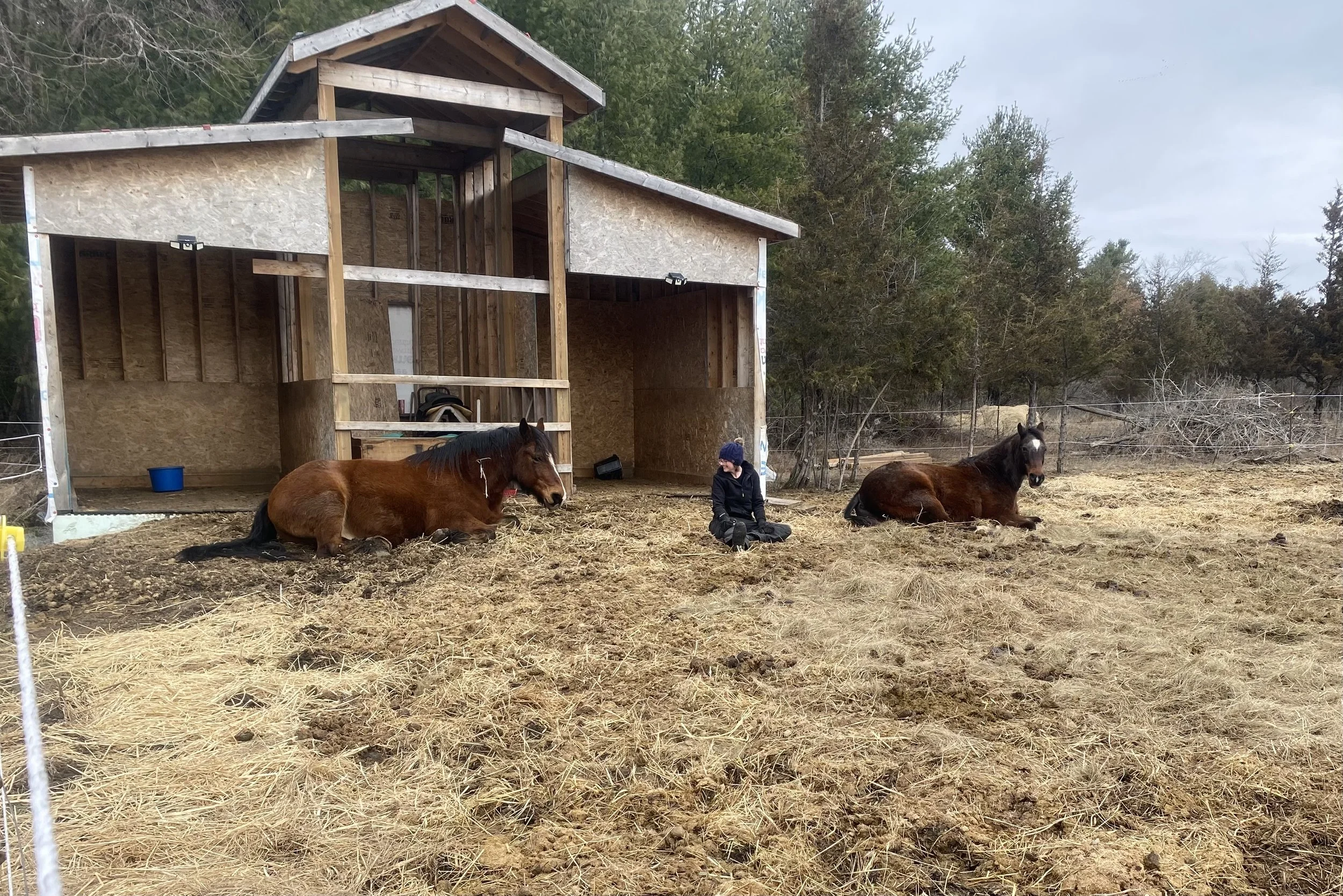
A quiet moment with the horses — one of the clearest places I see the nervous system in action.
What Is the Nervous System? A Plain-Language Guide to Stress, Safety, and Regulation
Part of the 'What Your Body Is Trying to Tell You' series
Most people hear the phrase "your nervous system" all the time — especially when talking about stress, anxiety, overwhelm, or trauma — but very few people actually know what it means. And honestly, why would they? No one ever teaches it in a way that feels human or understandable.
When I explain it to clients, I often draw from my nursing background because that's where the real picture becomes clear. We talk about the mind like it's separate from the body, but the nervous system doesn't work that way. It's deeply physical, deeply automatic, and deeply relational. It shapes how you feel, how you respond, how you cope, and even how you connect to other people.
Let's talk about it in a way that makes sense — not like a science lecture, but like a conversation.
Your Nervous System Is Your Body's Internal Communication System
Running from your brainstem down through your chest and abdomen is a long nerve called the vagus nerve — one of the main lines your brain and body use to talk to each other. It reaches your heart, your lungs, your voice, your digestion. It's a real and important piece of the picture, but it's not the whole picture — your nervous system is a much bigger, constantly-running network, and the vagus nerve is one major road in it, not the control switch for how safe or overwhelmed you feel.
This is why stress doesn't stay "in your head." Your nervous system sends its messages everywhere.
Your chest tightens. Your stomach flips. Your breath shortens. Your sleep changes. Your mood shifts. Your shoulders rise without you noticing.
Your body responds long before your thoughts catch up.
It's Not a Switch — It's a Dial
People often imagine the nervous system as something that flips between two settings: stressed or calm, on or off, fight-or-flight or rest-and-digest. That's the version most of us were taught, and it's simpler than what's actually happening.
Here's what's closer to the truth: the two branches of your nervous system that drive this — the one that activates you and the one that settles you — aren't a light switch. They're both running all the time, and what you feel is the balance between them shifting, not one turning off while the other turns on.
Think of it less like a switch and more like a dial. Under real threat, the dial swings hard toward activation. On a good, easy day, it swings toward settling. Most of the time, you're somewhere in the middle, and both systems are still doing their quiet background work even when one is louder than the other.
This matters because it explains things the switch story can't. Why you can feel your heart racing while your breathing stays steady. Why "calm" and "activated" aren't a clean either/or — you can be partly keyed up and partly settled at the same time. Your nervous system isn't choosing one state; it's constantly recalculating the balance based on everything it's taking in.
Neither direction is good or bad. Both keep you alive. Both shift without your permission.
Why You Can't Think Your Way Out of Stress
Here's something people find relieving:
Your nervous system responds before you do.
You don't choose for your heart to speed up in a hard conversation. You don't choose to feel overwhelmed before a holiday gathering. You don't choose to get irritable when your system is overloaded.
Your body reacts first. Your thoughts come after.
Your nervous system is picking up on tone of voice, facial expressions, the pace of your day, emotional pressure, old memories, sensory overload, exhaustion, or simply the feeling of "too much" — and shifting that internal dial in real time, often before you consciously register what's happening.
This is why stress feels so physical.
Because it is physical.
A Farm Moment That Explains It Perfectly
Horses have some of the most sensitive nervous systems of any domestic animal. Their survival depended on detecting subtle danger before the rest of the herd. When something shifts in their environment — a sudden noise, a rustle in the trees, a change in the wind — their entire body notices at once.
I've watched one of our horses go from soft, slow grazing to full alert instantly: head up, breath held, muscles pulled tight like a bowstring. That's the dial swinging hard toward activation, the same shift we feel as fight-or-flight.
Their heart rate increases. Their breathing becomes shallow. Every muscle prepares to move.
But here's the part that always stays with me: when the moment of potential danger passes, horses don't stay stuck. Their body completes the response. Their breath deepens, their muscles loosen, their tail softens. Sometimes they shake their entire body in one big, visible release — the dial swinging back the other way. (If you want to learn more about what happens when the stress response doesn't get to completion, I wrote a separate blog about escaping the hippo and understanding the stress cycle — you can read it here.)
They don't shame themselves for reacting. They don't overthink it. They don't push through. They don't say, "I shouldn't be stressed."
They simply let the cycle finish.
Humans often don't. We get triggered or overwhelmed, and instead of releasing the tension, we layer on expectations, pressure, self-judgment, productivity, and emotional labour. We brace instead of settle.
Watching the horses reminds me that regulation isn't about staying calm — it's about being able to come back. To return. To let your body know that the moment has passed.
Your body is built to do this too. It may just need space, permission, and a little support to remember how.
How the Nervous System Becomes Overloaded
People often come to therapy saying things like:
"I'm fine but I don't feel fine." "Everything feels loud." "I don't know why I'm so tired." "I'm snapping at everyone." "I can't slow down." "Nothing is wrong, but something feels off."
This is often the dial sitting further toward activation than the moment calls for — not because anything dramatic is happening, but because it's been nudged that direction so many times, for so long, that it hasn't had a real chance to swing back.
It's the quiet kind of overwhelm — the one that doesn't show up dramatically but slowly erodes your energy, patience, and sense of self.
You're not failing. Your system is tired.
Supporting Your Nervous System Gently
You don't need a perfect routine or a long meditation practice to help your body. Your nervous system responds to small, consistent cues of safety.
A slower breath than the one before. A moment to exhale fully. Letting your shoulders drop for two seconds. Eating before you crash. Stepping outside to feel the air. Letting yourself soften instead of push.
These micro-moments matter. They remind your body that it's allowed to settle.
Want to Learn More? Here are gentle, helpful starting points
Books:
Anchored by Deb Dana — a warm, accessible guide to the vagus nerve and regulation, written from a clinical/polyvagal-informed perspective (worth knowing some of the underlying theory is still debated among researchers — but the practical tools are widely used and helpful)
Waking the Tiger by Peter Levine — gentle somatic explanations of how the body releases stress
Anxious by Joseph LeDoux — written by the neuroscientist behind much of the original amygdala research, and a good corrective to some of the more oversimplified "fear center" language that's become popular
If Your Nervous System Has Been Working Overtime… You're Not Alone
If you've been feeling overwhelmed, disconnected from yourself, or stuck in survival mode, you may need support
I offer virtual therapy across Ontario with a strong focus on the mnd body connection and stress.
If your nervous system has been working overtime, you don't have to navigate that alone. Understanding what's happening in your body is often the first thing that helps. Your first session is a good place to start.
Learn more about working together →
Continue reading: → When Your Nervous System Is Dysregulated: The Hidden Symptoms Nobody Talks About → When Rest Feels Unsafe: Why Slowing Down Can Make Anxiety Worse