

Nervous System Healing and Trauma Recovery: What Regenerating Our Farm Taught Me About Both
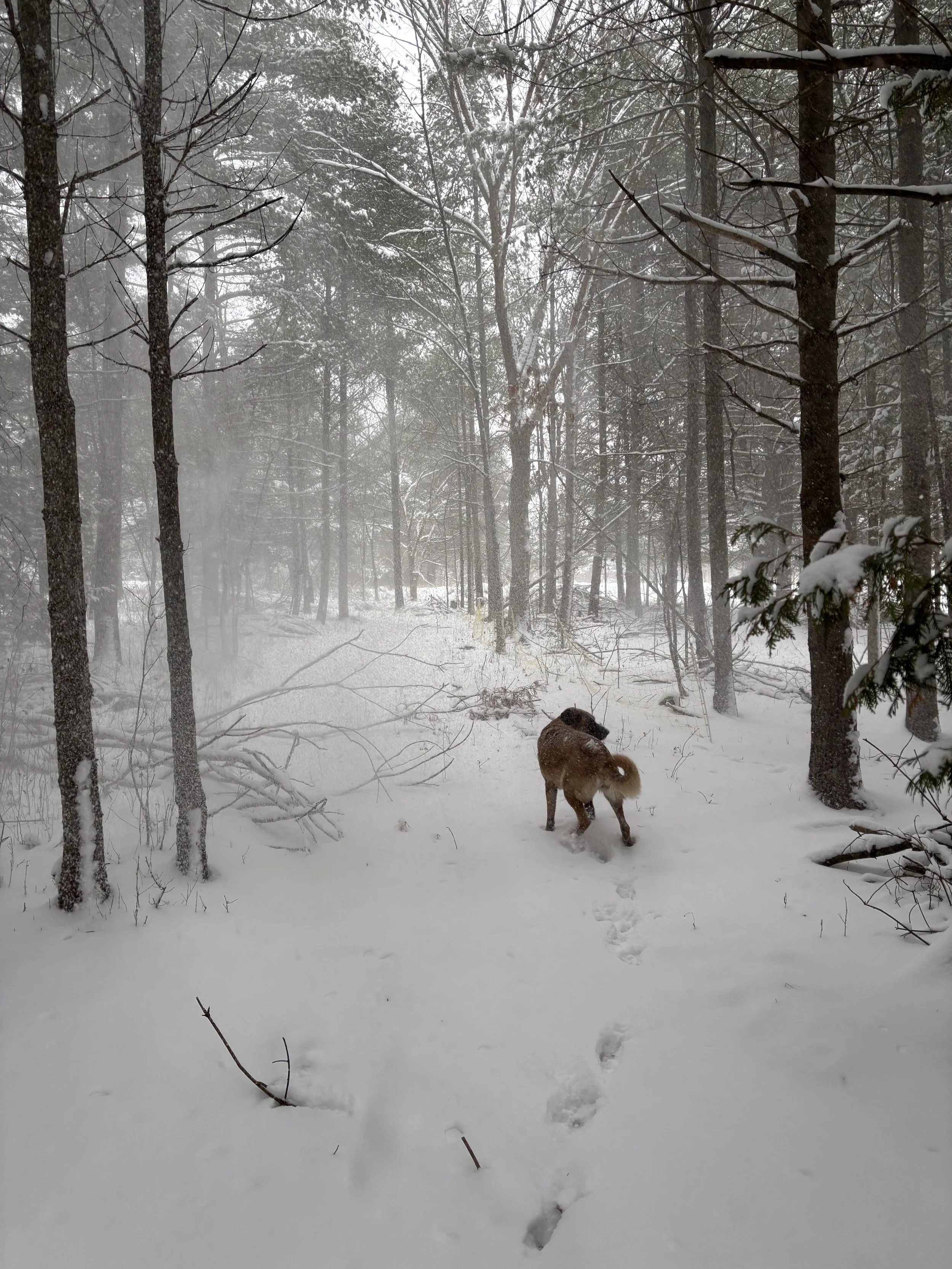
Rosie in a quiet, snow-covered forest, symbolizing the stillness and internal rebuilding that happens in healing, long before visible change appears
In my last post (click here) I talked about moving here six years ago and discovering that the land was, quite literally, dead. What that looked like wasn’t dramatic it was subtle in the way neglected ecosystems often are. The grass was spindly and brittle; it grew just enough to fall over and smother out anything new trying to come through. The soil underneath was hard and compacted, the kind of ground you can hit with your boot and feel nothing give back.
Plants need sunlight, space, and airflow to grow. This land had none of that. Everything was suffocating everything else.
So we started the slow work of regeneration.
How We Regenerated the Land
The first thing we did was lay hay down a thick layer that held moisture and, thanks to the goats, added natural fertilizer. That jump-started the micro-ecosystem underneath the surface, which is the real powerhouse of healthy soil. The part no one sees. The part where transformation begins long before anything looks different from above.
As the hay decomposed, the soil softened. Worms moved in and began aerating the compacted ground. That’s when we planted a whole mix of plant species. Biodiversity is how land heals. Different plants support each other like clovers fixing nitrogen levels in the soil so grasses can root deeply.
Then we introduced different types of animals.
A mix of ruminants and non-ruminants helps keep parasite populations balanced and prevents any one species from overwhelming the herd.
And slowly but reliably the land shifted from survival mode to something closer to balance. Not perfect. Not pristine. But alive.
Healing Requires Biodiversity Not One Magic Tool
In healing, many people want one magic solution: one skill, one perfect boundary, one routine, one breathing technique that finally makes everything click.
Another thing we learned while regenerating the land is that no two pastures respond the same way. We can roll out hay in one field and watch it jump-start the soil, soften the ground, and bring life flooding back. Then we try the same thing in a pasture right beside it… and nothing changes. The soil biology is different. The compaction is different. The stress history is different. The needs are different.
There is no three-step program in regenerative agriculture, because ecosystems don’t follow formulas they follow conditions.
Human healing works the same way.
A coping strategy that transforms one person might barely touch another. A grounding practice that helps you in winter might not help you in summer. A boundary that felt impossible last year might feel natural next month. You are not doing anything wrong. Your internal ecosystem simply has different needs, different layers, and different timelines.
Just like land, your nervous system responds to the right supports for its own landscape, not the ones that worked somewhere else. But it’s very clear that monoculture is not the way.
If we had planted only one species of grass, the soil would still be struggling.
If we had relied on only one type of animal, parasites would have wiped out the herd.
If we had skipped the hay layer because results weren’t immediate, we would have missed the foundation everything depended on.
Healing requires combinations.
Variety.
Multiple supports working together over time.
Nitrogen-fixing clover support grasses.
Grasses create shade and moisture for new plants.
Worms break up compaction.
Goats fertilize soil.
Different grazing species strengthen the pasture instead of stripping it.
There is no single “best plant.”
There is only the right ecosystem.
And the same is true for trauma recovery and nervous system healing.
There is no perfect meditation practice.
No perfect journal prompt.
No perfect therapy tool that fixes everything.
Healing is a constellation of practices that work in relationship with one another:
rest
movement
boundaries
connection
emotional expression
nourishment
somatic awareness
co-regulation with others
time in nature
therapeutic support
Some will help immediately.
Others will work quietly underground for months before you notice anything changing.
Just like soil regeneration, most of the real work happens beneath the surface.
Trauma Narrows Your Internal Ecosystem — Healing Restores It
When an ecosystem is stressed or damaged, biodiversity collapses.
You go from dozens of species to one or two. Ever wonder why wild parsnip has taken over so aggressively? It only happens in lands that biodiversity isn’t supported in. It’s also seen with stinging nettles and the thistles. You’ll actually notice in the summar that while wild parsnip is all around our farm there isn’t any where the goats graze because they eat it before it can go to seed (Goats can sometimes be helpful but it’s a very narrow window!)
Everything becomes rigid, fragile, and easily overwhelmed and sometimes dangerous like with the wild parsnip.
Trauma does the same to the nervous system.
When you’ve lived in survival mode, your internal ecosystem narrows. You may have only one dominant response:
shutting down
freezing
people-pleasing
overworking
avoiding
withdrawing
bracing for impact
These patterns aren’t flaws they’re monoculture.
They grew because the system was trying to survive.
But monoculture is fragile.
It takes only one stressor, one conflict, one unexpected emotion for the whole system to collapse or overload.
Healing isn’t about achieving calm.
Healing is about restoring internal biodiversity.
It’s about adding back:
rest
flexibility
curiosity
emotional range
the ability to say no
the ability to say yes
play
joy
grief
self-compassion
movement
grounding
connection
boundaries
stress tolerance
These are the “species” your internal ecosystem needs.
And healing doesn’t happen all at once just like our farm didn’t go from dead soil to balanced pasture in a single season.
The first signs of recovery were messy:
First came worms… and then rats… then we got an owl and foxes to balance them out. Which was a lot of trial and error to work through these stages.
Early healing often looks the same:
anger returns
anxiety spikes
old memories surface
emotions feel bigger
exhaustion hits
These aren’t signs of failure.
These are signs that the underground system is waking up.
Rats before owls.
Chaos before balance.
Life before order.
Over time, as biodiversity increases, resilience grows.
You become less thrown by storms.
Less overwhelmed by emotion.
Less dependent on one survival pattern.
More adaptable.
More grounded.
More you.
Your nervous system isn’t meant to be a monoculture.
It’s meant to be a meadow complex, relational, self-sustaining.
And if your internal ecosystem feels depleted or narrow right now, it doesn’t mean you’re broken.
It simply means the regeneration is beginning.
Resources to Support Your Healing Ecosystem
Books
Anchored by Deb Dana — Polyvagal basics made accessible
The Body Keeps the Score by Bessel van der Kolk — Understanding trauma’s impact
Burnout: The Secret to Unlocking the Stress Cycle by Emily Nagoski — The stress cycle explained simply also she has some other amazing books like Come As You Are
Braiding Sweetgrass by Robin Wall Kimmerer — Nature, reciprocity, and regeneration
Podcasts
“On Being” with Krista Tippett (episodes on connection + ecology)
“Huberman Lab” — Stress & Neuroplasticity
“Therapy Chat” — Somatic and trauma-informed approaches
Somatic + Nervous System Tools
Orienting (Deb Dana)
Polyvagal-informed grounding
Physiological sigh (Huberman)
Co-regulation through animals or trusted people
Slow, titrated exposure to emotional sensations
Nature-Based Supports
Walking on uneven ground
Touching soil or snow
Watching animals settle or graze
Listening to birds or wind
Sitting with a warm drink outdoors
Your ecosystem doesn’t need to be perfect.
It needs to be diverse enough to adapt. Every ecosystem needs a starting point. If you're ready to begin restoring your internal landscape, therapy can be the first layer the hay, the moisture, the nourishment that helps your deeper healing take root.
If your internal ecosystem feels depleted or narrow right now, therapy can be the first layer — the hay, the moisture, the nourishment that helps deeper healing take root. Your first session is just a conversation. Learn more about working together →
Related reading:
→ Healing Isn't the Absence of Stress: What Our Farm's Ecosystem Taught Me (Part 1 of this series)
→ When Your Nervous System Is Dysregulated: The Hidden Symptoms Nobody Talks About