

How Long Does Burnout Recovery Actually Take?
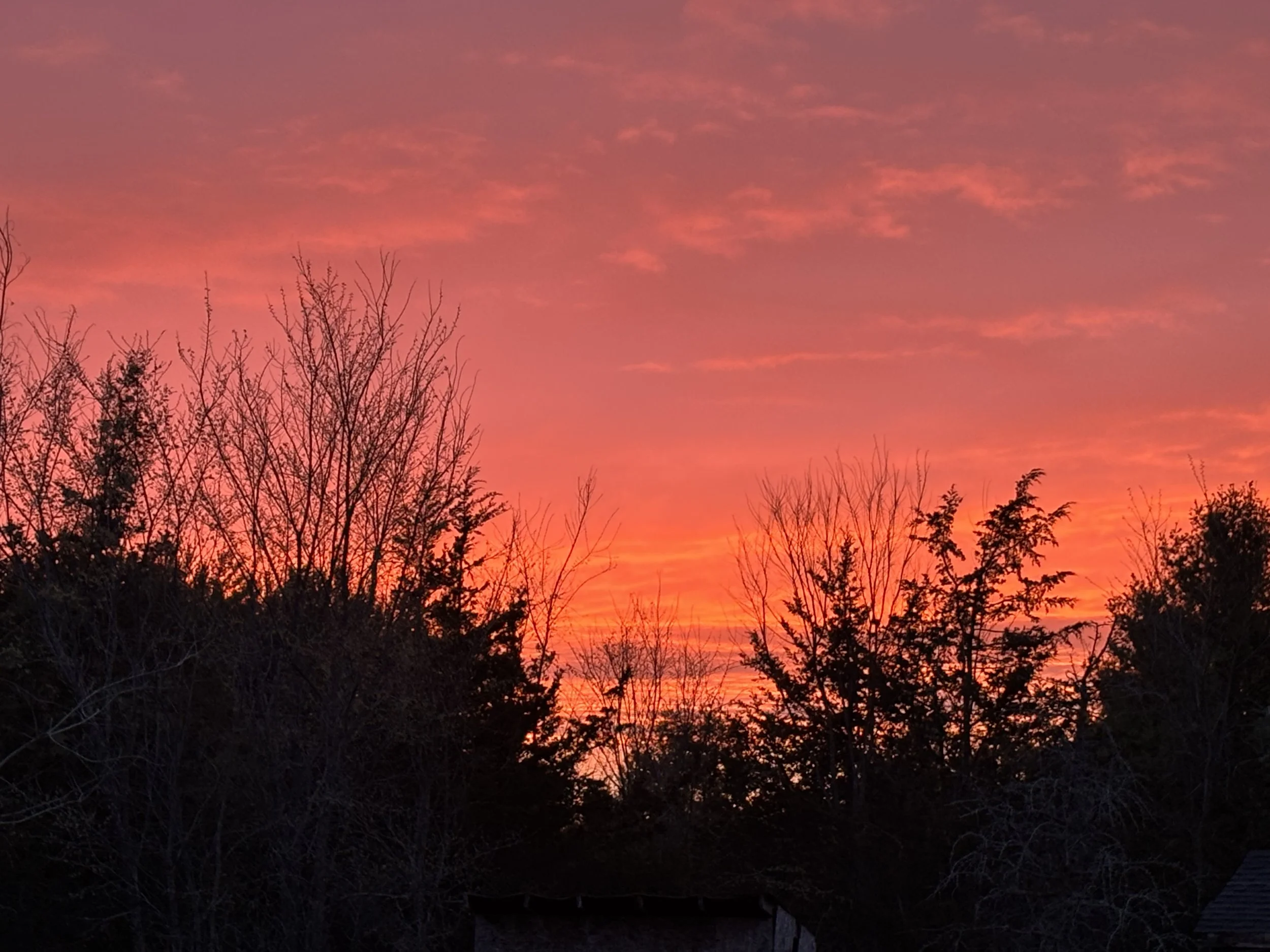
Red and orange sunset through trees at Wandering Willow farm near Newburgh Ontario
The honest answer is: longer than most people expect—and different from what most people imagine.
Which isn’t what anyone wants to hear. But it’s more useful than promising a timeline that doesn’t hold.
Here’s what I’ve observed, both as a nurse who watched chronic stress play out in people’s bodies, and as a therapist working with people in the middle of it.
What Burnout Actually Does
Burnout isn’t just tiredness. It isn’t just stress that got a bit too heavy.
It’s what happens when your system has been running on override for long enough that it stops being able to return to baseline on its own.
Your nervous system has learned a new normal. Your body has adapted not in a healthy way, but in a survival way.
Think of it like this:
Imagine a garden that’s been thriving. Good soil, healthy roots, things growing the way they’re supposed to.
Now imagine someone pours a load of gravel into that garden not a little, but a significant amount.
Enough to change the composition of the soil underneath.
That’s burnout.
The garden doesn’t just spring back when you remove the gravel. The soil has been compacted. The structure has changed. The roots that were there have had to work differently just to survive. Some of them didn’t make it.
You can add new soil. You can tend to it carefully. Things can grow again and often do.
But the garden is different now.
And pretending otherwise doesn’t help you take care of it properly.
What Recovery Actually Looks Like
Most people come into burnout recovery expecting to return to who they were before.
That’s understandable.
It’s also often not what happens and when it isn’t, people assume they’re failing at recovery rather than understanding that recovery sometimes means something different than return.
Recovery from burnout can look like:
Regaining energy, but needing to protect it more consciously than before
Capacity returning, but tolerance for certain environments, relationships, or ways of working being permanently lower
Understanding what drove the burnout and making structural changes not just coping strategy changes
Learning to notice early signals the ones that were always there but got drowned out
This is the work most people skip because it’s harder.
It’s easier to add a morning routine than to change a job, leave a relationship, or stop saying yes to things that drain you.
Clinically, this is what I find most interesting:
Most people who burn out severely didn’t miss the signs because they weren’t there.
They missed them because the signals were quiet and everything else was loud.
Recovery is often less about returning to full capacity and more about recalibrating what full capacity actually means for you now.
The Gravel Keeps Wanting to Come Back
Here’s the part that doesn’t get talked about enough.
Even after significant recovery, even after the new soil has been added, the roots have regrown, and things are genuinely better, the gravel still exists.
The conditions that created burnout are still often present.
The personality traits that made you susceptible are still yours.
The environment, in many cases, hasn’t changed.
So the gravel slips back in.
Not always dramatically. Often, gradually, quietly, in ways that are easy to rationalize:
One more commitment
One more difficult month
One more thing you’ll deal with later
This isn’t a sign that recovery failed.
It’s just the nature of maintaining a changed garden.
It needs more attention than one that was never disrupted, not forever, but for longer than most people plan for.
The people who do best in burnout recovery aren’t the ones who push hardest during the acute phase.
They’re the ones who build in ongoing maintenance:
Checking in before hitting the red line
Noticing quiet signals early
Adjusting before things escalate
So How Long Does It Actually Take?
Research suggests:
Mild to moderate burnout can improve within 3–6 months with the right support and changes
Severe burnout can take 1–3 years, sometimes longer
But those timelines assume something important:
The underlying conditions change.
Gravel stops being added while recovery is in progress.
In reality, many people are trying to recover while:
Staying in the same environment
Saying yes to everything
Running at the same pace with slightly better coping
That’s not recovery.
That’s management.
And management is better than nothing, but it has a ceiling.
What Real Recovery Usually Requires
Real recovery often includes at least some of the following:
Reducing the load
Not just managing it better something actually changesAdequate rest
Not just sleep, but restorative rest (which looks different for everyone)Time
More than feels reasonable when you’re in itSupport
Therapy, medical care, or bothUnderstanding what happened
Not just what triggered burnout, but what made you vulnerable to it
This is where therapy tends to be most useful.
What This Means in Practice
If you’re in burnout recovery or wondering if this is what you’re experiencing here are a few honest things to sit with:
The goal isn’t necessarily to get back to who you were before
Sometimes who you were before was a person running too hard for too long
The goal is a sustainable garden
One that can handle some gravel without being overwhelmed.
One that has enough good soil underneath that the roots hold.
That might mean permanent changes to:
How you work
What you commit to
What you’re willing to tolerate
Those aren’t failures of recovery.
They’re often the recovery.
And if things start to slip, if you notice the gravel accumulating again, that’s the most useful moment to act.
Not after the breakdown.
Not after the crisis.
Not after the red line.
Before.
That’s the work I’m most interested in therapy:
Not just managing the crisis but learning to hear yourself before things get loud.
If this resonates and you’re wondering whether therapy might help, your first session is a low-pressure conversation.
No agenda. No expectation that you have it figured out.
→ Book your first session at https://aws-portal.owlpractice.ca/wanderingwillow/booking